As an Amazon Associate this site earns from qualifying purchases.
Comparison table
| Kennel | Price | Size | Roof material | Feeder included | Lock design | Anchoring |
|---|---|---|---|---|---|---|
| COMHOMA 10×10FT with Roof | Check price on Amazon | 10x10FT (124in) | Waterproof, UV-resistant spire canopy | No | Reinforced lockable gate | Ground stakes |
| YITAHOME 10'x10' Enclosure | Check price on Amazon | 10'x10' | Waterproof, UV-resistant canopy | No | Upgraded door lock | Not stated |
| COMHOMA 7.5×7.5FT with Roof | Check price on Amazon | 7.5x7.5FT | Waterproof, UV-resistant spire canopy | No | Reinforced lockable gate | Ground stakes |
| COMHOMA 10×10FT with Bowls Feeder | See the product list on this page | 10x10FT (124in) | Waterproof, UV-resistant spire canopy | Yes — 360° rotating, height adjustable | Reinforced lockable gate | Ground stakes |
| ATTAV Large Outdoor Enclosure | Check price on Amazon | 78"W x 78"D x 65"H | PE fabric, rain/dust/UV/light snow | No | Double safety locks | Ground stakes |
| Sino Luban 8x4x6FT | Check price on Amazon | 8x4x6FT | Oxford fabric, waterproof + UV-resistant, sloped | Yes — 2 stainless bowls, 360° rotating door | 2 latches + 2 carabiners | 10 ground stakes + 4 expansion bolt brackets |
Quick answer: For most people with a decent-sized yard and a dog who needs room to move, the COMHOMA 10×10FT Outdoor Dog Kennel with Roof at $209.98 is the sensible default — a full 10×10 footprint, a waterproof spire-shaped canopy, and ground stakes for stability. If your yard is tight or your budget is tighter, the $121.98 ATTAV 6.56'×6.56' kennel covers the basics. And if you're building a genuine dog run that connects to a dog house, the Sino Luban 8x4x6FT is the one shaped for that job.
An outdoor kennel is one of those purchases where the differences between models look tiny on a listing page and feel enormous once it's bolted into your lawn. Footprint, roof design, lock hardware, and whether you can feed the dog without opening the door — those are the things you'll notice every single day. Below is what the specs actually say about each of these six, and who each one genuinely fits.
COMHOMA 10×10FT Outdoor Dog Kennel with Roof — Best Overall
At $209.98, the COMHOMA 10×10FT Outdoor Dog Kennel with Roof hits the size most people are actually looking for when they search "backyard dog kennel." Ten feet square (124 inches per side) is enough for a medium-to-large dog to trot rather than just turn around.
The best best outdoor dog kennels for your situation depends on how you plan to use it and where.
The frame uses thickened steel tubes with reinforced chain link panels, and COMHOMA specifically calls out rounded, smooth edges — a small detail that matters if you have a dog who body-slams panels or a kid who wanders near it. The galvanized surface is there for corrosion resistance, which is the whole ballgame with metal that lives outside year-round.
The roof is the part worth paying attention to. It's a waterproof, UV-resistant canopy with a spire design, meaning water, debris, and light snow shed off rather than pooling in the middle — the failure mode that kills flat-top canopies. Included ties secure the edges so it doesn't flap loose in wind. Ground stakes come in the box, and the gate is reinforced and lockable.
Who it's for: the default buyer. Medium or large dog, real yard, wants one purchase that handles sun and rain without a second thought.
YITAHOME 10'x10' Outdoor Dog Enclosure — Best for Mixed Animals
The YITAHOME 10'x10' Outdoor Dog Enclosure with Metal Dog Gate is $205.59 — a few dollars under the COMHOMA at the same 10×10 footprint — and it's built from galvanized thick steel pipes with an upgraded door lock designed to prevent accidental opening.
What sets it apart in the listing is scope. YITAHOME explicitly positions it for chickens, rabbits, and ducks as well as dogs, which is a genuinely different pitch from the dog-only models here. If you're a hobby-farm household who wants one enclosure that might hold a dog this year and poultry next, that flexibility is real.
It ships with a waterproof, UV-resistant canopy and a lockable door sized for easy feeding and cleaning access. Assembly gets an upgraded manual with numbered accessories, and gloves are included — a small kindness when you're handling cut steel edges for an hour.
Who it's for: multi-species households, or anyone who wants a 10×10 with a slightly more general-purpose design.
COMHOMA 7.5×7.5FT Outdoor Dog Kennel with Roof — Best for Smaller Yards
Same construction story as the flagship, smaller footprint. The COMHOMA 7.5×7.5FT Outdoor Dog Kennel is $189.99 in gunmetal, and it's the answer when 10×10 simply doesn't fit between the deck and the fence line.
You get the same thickened steel tube frame, the same reinforced chain link panels, the same galvanized rust-resistant finish, and the same spire-design waterproof, UV-resistant canopy with securing ties. Ground stakes and a reinforced lockable gate are included. COMHOMA notes the kennel line suits active dogs like Border Collies as well as small pets such as rabbits.
Here's the honest tension: you're saving $20 over the 10×10 and giving up roughly 44% of the floor area. If the 10×10 fits your space, buy the 10×10. Buy this one because of your yard, not because of your budget.
Who it's for: small or awkwardly shaped yards, patios, and side-of-house installs where the full square just won't go.
COMHOMA 10×10FT Outdoor Dog Kennel with Adjustable Bowls Feeder — Best for Daily Feeding
Twenty dollars more than the base 10×10, and the COMHOMA 10×10FT Outdoor Dog Kennel with Adjustable Bowls Feeder at $229.99 adds the one upgrade that changes your routine rather than just your specs.
It includes a 360°-rotating, height-adjustable dog bowl feeder. COMHOMA's pitch is that it reduces spills and supports a healthier eating posture, and the height adjustment means it grows with a puppy or accommodates a tall breed. The rest of the build is identical to the flagship: rust-resistant galvanized structure, thickened steel frame, ground stakes, reinforced lockable gate, and the waterproof UV-resistant spire canopy with edge ties.
If you feed your dog in the kennel twice a day, that's roughly 730 interactions a year with the feeding setup. Twenty dollars is cheap for making 730 things easier.
Who it's for: anyone whose dog eats in the kennel, and anyone who'd rather not carry a bowl through a gate in the rain.
ATTAV Large Outdoor Dog Enclosure — Best Budget Pick
At $121.98, the ATTAV Large Outdoor Dog Enclosure is by a wide margin the cheapest kennel here, and it doesn't feel gutted to get there.
Dimensions are 78"W x 78"D x 65"H — that's 6.56 feet square and just under five and a half feet tall. ATTAV pitches it at small to medium dogs, which is the right call; the height in particular is worth measuring against your own head before you buy, because you'll be ducking to go in. Construction is thicker galvanized metal with steel wire mesh, plus ground stakes for stability, and the door uses double safety locks.
The roof cover is PE fabric rated against rain, dust, UV, and light snow. ATTAV is refreshingly direct about its limit: they recommend removing the cover during heavy snowfall. Assembly is fully unassembled DIY, about an hour with two people, with instructions and gloves included.
Who it's for: small-to-medium dogs, first-time kennel buyers, or anyone who wants outdoor containment without spending $200-plus.
Sino Luban Dog Kennel Outdoor 8x4x6FT — Best for Dog Runs
The Sino Luban Dog Kennel Outdoor, 8x4x6FT is $189.99 and shaped completely differently from everything else here — 8 feet long by 4 feet wide by 6 feet tall. That's a run, not a square pen, and it's the right geometry for a dog who paces rather than lounges.
The build is the most heavily specified of the group: fully welded high-strength iron wire panels on galvanized tubes with electro coatings, which Sino Luban describes as a dual anti-rust system, and which they say resists chewing and bending. The door uses two standard latches plus two carabiners for a genuine double-lock mechanism — the strongest escape-resistance story in this roundup.
Two things make it the pick for serious setups. First, it comes with two stainless steel bowls on a 360° rotating feeder door, and that feeder door is removable so the kennel can connect to a dog house — your dog moves between the run and a warm sleeping box without you opening anything. Second, the expandable design lets you connect two or more kennels into a larger area, useful for multi-dog homes.
It ships with 10 ground stakes for lawn anchoring and 4 expansion bolt brackets for concrete or wall mounting. The Oxford fabric roof is waterproof and UV-resistant with a sloped design to shed rain and snow, and it can be removed to use the enclosure indoors.
Who it's for: long narrow spaces, multi-dog households, and anyone pairing a kennel with an existing dog house.
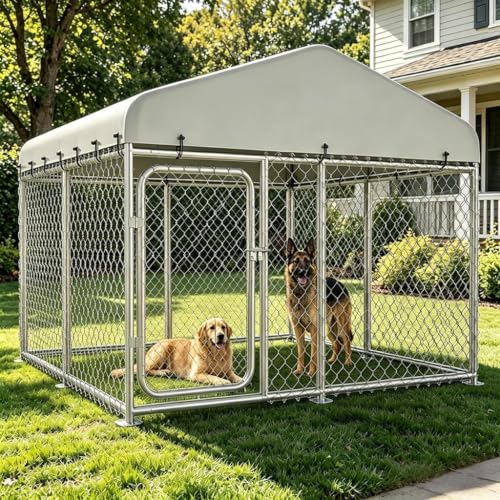
- 【Rust Resistant Structure】Built with a tough metal frame and reinforced chain link panels,this heavy duty dog kennel is made to handle energetic dogs.The galvanized surface helps
- 【Upgraded Thick Steel Frame】Built with thickened steel tubes,this outdoor dog kennel reduces wobbling and improves overall safety.The smooth,rounded edges help prevent
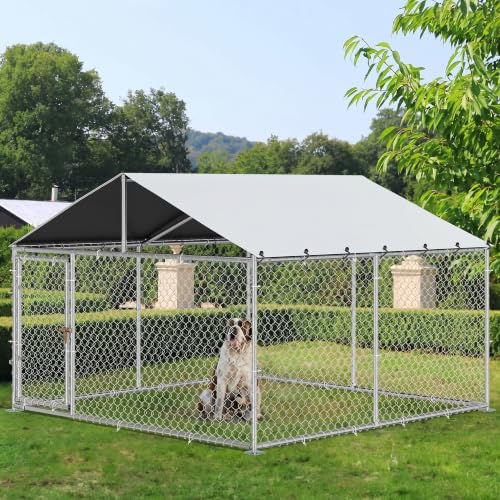
- Durable Materials: This outdoor dog cage is made from galvanized thick steel pipes to ensure high strength and durability; The overall structure remains stable; The upgraded door
- Versatile Applications: Our outdoor dog kennel offers abundant room for dogs to play, run, and exercise; Not limited to dogs alone, it can also serve as an ideal sanctuary for
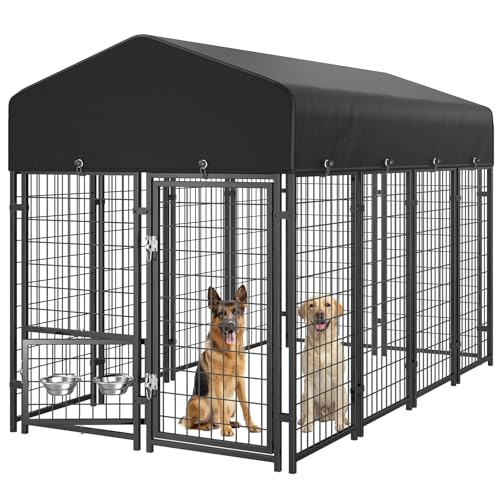
- 【Heavy Duty Metal Construction for Outdoor Use】Built with fully welded high-strength iron wire panels and rust-resistant galvanized tubes finished with electro coatings, this dog
- 【Escape-Resistant Door Lock Design】Equipped with an upgraded secure latch system, the outdoor dog kennel door combines two standard latches with two carabiners to create a
How to choose an outdoor dog kennel
Measure your yard before you measure your dog. Every 10×10 here needs a genuinely flat 10-foot square plus room to walk around it. Stake out the footprint with string first. The COMHOMA 7.5×7.5 and the ATTAV exist because a lot of yards can't take the big one.
Look at the roof geometry, not just the fabric. Flat canopies pool water and sag. COMHOMA's spire design and Sino Luban's sloped roof are both engineered to shed. ATTAV is honest that its PE cover should come off in heavy snow — treat that as a spec, not a flaw, and factor it into your winter plans.
Take the locks seriously if your dog is a problem-solver. A single latch is enough for most dogs. The Sino Luban's two-latch-plus-two-carabiner system and the ATTAV's double safety locks are what you want for a dog who has already escaped something.
Decide now whether you'll feed inside. Retrofitting a feeder is a hassle. The COMHOMA with the adjustable bowls feeder and the Sino Luban with its rotating feeder door both let you feed without opening the gate, which is a genuine daily quality-of-life difference.
Think about anchoring surface. Most of these ship with ground stakes, which assume lawn or soil. Sino Luban is the only one here that also includes expansion bolt brackets for concrete or wall mounting — relevant if you're installing on a patio.
Assume it's a two-person, one-hour job. ATTAV states about an hour with two people. Everything here arrives flat-packed. Clear an afternoon and recruit a helper.
FAQ
Do outdoor dog kennels need a roof? If the kennel is used for anything longer than supervised play, yes. Every kennel in this roundup includes one, and all of them are described as both waterproof and UV-resistant — sun exposure is as much the problem as rain. A roof also keeps the ground underneath from turning to mud.
Can these kennels double as enclosures for other animals? YITAHOME explicitly lists chickens, rabbits, and ducks alongside dogs. COMHOMA notes its kennels suit small pets such as rabbits as well as active dogs. If multi-species use is your plan, those are the listings that say so directly.
Can I connect two kennels together? The Sino Luban 8x4x6FT is the one designed for it — its expandable design lets you join two or more units into a larger run, and its removable feeder door lets you attach a dog house. None of the other listings here describe that capability.
How do I know a kennel will actually hold up in my climate? Start with the material spec — galvanized steel and welded panels are the baseline, and Sino Luban's electro-coated dual anti-rust description is the most detailed here. Then go read the recent owner reviews on the product page yourself, filtering for people in a climate like yours. That's where seasonal, long-term durability information actually lives.
Related guides
- Best dog and cat supplies - dog crates, cat trees, dog beds, litter boxes, pet kennels and cat condos with Limited History
- Top 10 Tips for Best dog and cat supplies - dog crates, cat trees, dog beds, litter boxes, pet kennels and cat condos
- Best dog and cat supplies - dog crates, cat trees, dog beds, litter boxes, pet kennels and cat condos for Seniors
Key Takeaways
- Choosing the right best outdoor dog kennels means matching the key features to your specific needs and budget
- Read real customer reviews and check the return policy before you commit
- Compare value across models — the priciest option is not always the best fit