As an Amazon Associate this site earns from qualifying purchases.
Specs at a glance
| Product | Price | Adjustable height | Levels | Weight capacity | Base footprint | Drilling |
|---|---|---|---|---|---|---|
| FUKUMARU Floor to Ceiling Cat Tree, 6-10 ft, 6 Level | Check price on Amazon | 6–10 ft | 6 | Up to 145 lbs | 14 x 14 in | Not stated |
| Cat Tree Floor to Ceiling, Cat Tower with Hammock & Perch, Scratching Post | Check price on Amazon | Not stated | Not stated (multiple perches) | Up to 150 lbs | Not stated | No drilling |
| PEQULTI Floor to Ceiling Cat Tree Tower, Height Adjustable 230-252cm, Brown | Check price on Amazon | 90.5–100.4 in (230–255 cm) | Not stated (multiple) | Not stated | Not stated | No drilling |
| PEQULTI Floor to Ceiling Cat Tree, Adjustable 83-108in 5-Level Tower, Green | Check price on Amazon | 83–108 in (210–274 cm) | 5 | Not stated | Not stated | No drilling |
| PETEPELA Floor to Ceiling Cat Tree, 83-108" Adjustable Tall Tower, Beige | Check price on Amazon | 83–108 in | Not stated (multiple) | Not stated | Not stated | No drilling |
Quick answer: Most cats ignore a new tree for one of four reasons — it wobbles, it's in a dead corner of the house, it smells like a factory, or nobody ever gave the cat a reason to climb it. Fix stability first, move it beside a window or next to the spot your cat already naps in, then use food and wand play to make the top level worth reaching. Give it two to four weeks before you decide the tree failed.
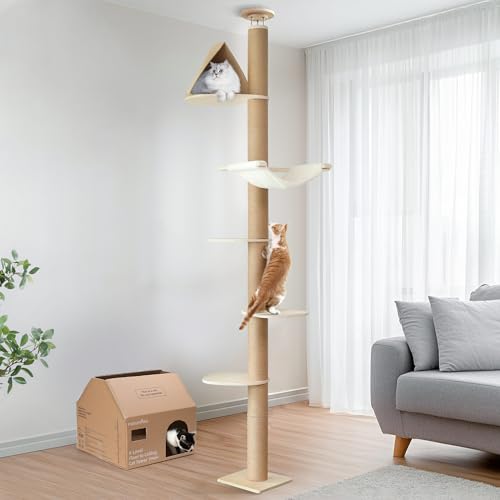
- STABLE SUPPORT - For large cat tree, stable structure is very important. The top structure of this floor to ceiling cat tree uses 3 reinforced screw rods to ensure product’s
- SATISFY NATURAL INSTINCT - Cats naturally like heights, climbing to high places can burn off their excess energy and enhance their sense of security. This 6 level tall cat tree
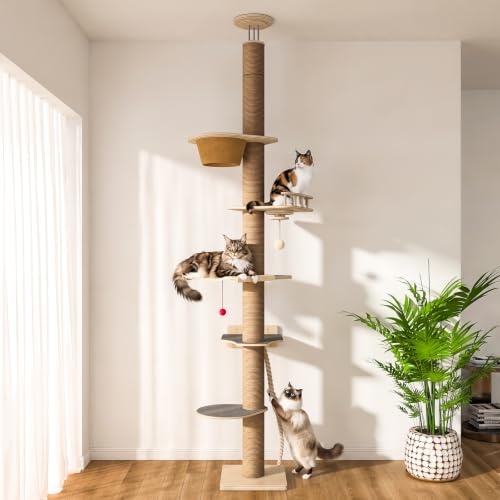
- Wall Mounted Cat Tree with 2pcs Non-Slip Carpet, Tall Sisal Scratching Post and Cat Shelves Perch with Wood Track Toy Ball, Cat Wall Shelf ClimbingTower for Indoor Middle Large
- Ideal for Multi-Cat Household : Recommend measuring the pieces and thinking about what your cats will like from step one! The activity center includes hammock for napping
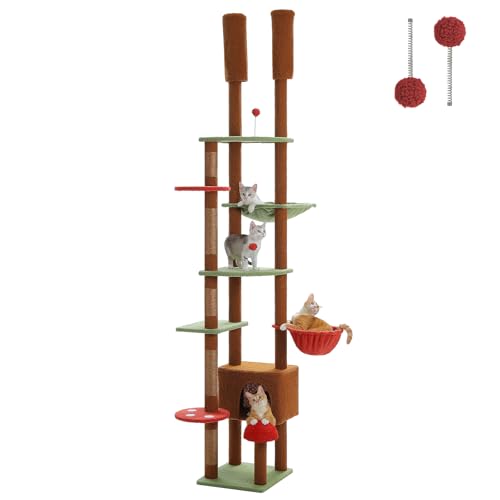
- Space-Saving & Adjustable Height: PEQULTI cat tree tower, with its floor-to-ceiling design, maximizes your space while offering a fun and relaxing area for your cats. The
- Ideal for Multi-Cat Households: Still worry about finding a cat tree for your naughty babies? With its multiple levels and resting spots, this cat tree is perfect for households
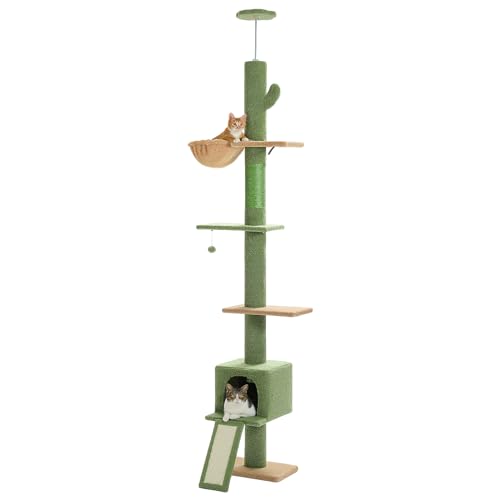
- Adjustable Cat Tree: Our PEQULTI floor to ceiling cat tree is designed to fit into any space with its adjustable height [210CM-274CM] feature, providing a tall cat tree that
- Various Colors to Choose From: We provide 6 colors on this cat tree so there are various choices for your preference. A cactus cat tree or a flower cat tree can be a fresh decor
Why cats ignore a new tree
It moves. This is the big one. A cat commits its full body weight to a leap, and if the platform shifts even slightly on landing, most cats will not try again. Floor-to-ceiling designs that tension against the ceiling are steadier than freestanding towers of the same height, which is why height-adjustable models exist in the first place.
It's in the wrong room. A cat tree is territory, not furniture. Put it where your cat already chooses to be — near a window with bird traffic, beside the couch you sit on, or in the room where the family gathers. A tree in the spare bedroom is a tree in storage.
Finding the right how to get cat to use cat tree comes down to matching the features to how you will actually use it.
It smells wrong. New carpet, sisal and adhesives smell like nothing your cat owns. Rub the platforms with a blanket your cat sleeps on, or place that blanket on the top perch. Skip citrus-scented cleaners near it entirely.
Nobody taught them. Never lift a cat onto a tree — being placed somewhere high with no exit route reads as a trap. Instead, lure upward.
The two-week plan
- Days 1–3: assemble and leave it alone. Tighten everything, check the tension against the ceiling with a level, and let the cat investigate on its own terms. Sprinkle catnip or silvervine on the lowest platform only.
- Days 4–7: pay for every level. Put a treat on step one. When it's eaten, put the next one a level higher. Feed regular meals on the bottom platform for a few days.
- Days 8–10: play upward. Drag a wand toy up and over the perches. End every session with the cat on the tree, then give the treat there.
- Days 11–14: make it the good spot. Move the cat's favourite blanket permanently to the highest perch it has reached. Groom or pet the cat while it's on the tree. Don't grab it off the tree for nail trims or medication — that spot has to stay safe.
The tree this guide is built around
FUKUMARU Floor to Ceiling Cat Tree, 6-10 ft, 6 Level
If the main obstacle is "my cat won't climb it because it moves," this is the design that addresses it most directly on paper. The listing describes three reinforced screw rods at the ceiling and a 5-inch-thick support column, with a stated load rating of 145 lbs — far beyond what any cat needs, which is the point: the margin is what keeps it from flexing under a landing.
The six levels matter for the training plan above, because they give you short hops rather than one intimidating jump. It includes an extra-large hammock, a semi-enclosed condo and a view perch, so a cat that wants to hide and a cat that wants to survey the room are both served. The structure is rubber wood plywood and jute; the hammock's faux fur is listed as machine washable, and the boards are wax-coated for wiping down. At 14 x 14 inches of floor space and a 6–10 ft adjustable range (middle columns removable for low ceilings), it's aimed at people short on floor area, not short on wall.
Who a floor-to-ceiling tree is for
Renters and apartment dwellers who can't drill into walls but need vertical territory. Multi-cat households, where the real problem isn't boredom but two cats sharing one floor — height creates separate zones and defuses a lot of low-grade tension. Anyone whose cat already sits on top of the fridge or bookshelf: that cat has told you exactly what it wants. And anyone with a sofa-scratching problem, since a tall sisal post gives the full-body vertical stretch a flat scratcher can't.
Who should skip it
Senior cats, very young kittens, and cats with arthritis or vision loss — a tall tower with wide gaps between levels is a fall risk, and a low, wide tower or a set of stepped perches serves them better. Skip it too if you have sloped, vaulted, textured or suspended ceilings, because ceiling tension needs a flat, solid surface to push against. If your cat has never shown any interest in height in years of living with you, buy a cheap window perch first and find out cheaply.
Honest trade-offs
Ceiling-tension towers trade footprint for setup fussiness. You have to get them genuinely vertical and genuinely tight, and you may need to re-tension after a few weeks as carpet compresses under the base. They also concentrate a lot of weight on one small floor patch — fine on hardwood, less predictable on soft carpet over a floating floor.
The cheaper models here ($69.99) don't publish a weight rating, which is exactly the spec that matters most for a large or enthusiastic cat. The more expensive ones publish theirs. That's not a guarantee, but it's a difference worth paying attention to. And no tower solves a placement problem: an $145 tree in the wrong room loses to a cardboard box in the right one.
What to check on the listing before you buy
- Current price. All prices above are point-in-time and these listings move.
- Height range vs your actual ceiling. Measure floor to ceiling at the spot you'll install it, and buy a model whose range brackets that number with room to spare. Note that the PEQULTI brown model's title says 230–252 cm while its description says 230–255 cm — confirm the current spec before ordering.
- Colour and variant. Two of these list six colour options; the price shown often applies to only some variants.
- Weight capacity if you have a Maine Coon, a Ragdoll, or two cats who will use it simultaneously.
- Warranty and return window, plus whether the seller ships replacement hardware — the most common failure on tension towers is a stripped or missing rod, not the wood.
- Go read the recent reviews yourself, filtered to the newest ones and to your specific variant. Manufacturers revise these designs, and the useful complaints are usually about assembly instructions and shipping damage.
Alternatives worth considering
Cat Tree Floor to Ceiling, Cat Tower with Hammock & Perch, Scratching Post — consider instead if…
…you want to arrange the perches yourself. Chuiendi's listing emphasises that you choose the order of the platforms, the height, and which direction each one faces, which is genuinely useful when you're trying to build a staircase your particular cat will climb. It's rated to 150 lbs, uses wood with anti-slip carpet and natural sisal, includes a hammock, a bed, a wood track ball toy and a climbing rope, and installs without drilling. At $112.93 it sits in the middle of this group, and the included toy set is handy for the luring stage.
PEQULTI Floor to Ceiling Cat Tree Tower, Height Adjustable 230-252cm, Brown — consider instead if…
…you want something that reads as decor. The mushroom-shaped scratcher is the hook here, and novelty shapes do sometimes trigger investigation in a cat that walks past conventional posts. It adjusts between 90.5 and 100.4 inches, needs no drilling, and is pitched at multi-cat homes with multiple resting spots. At $99.99 it's a reasonable middle option — just confirm the exact height range, since the listing states it two ways.
PEQULTI Floor to Ceiling Cat Tree, Adjustable 83-108in 5-Level Tower, Green — consider instead if…
…you're testing the concept on a budget. At $69.99 with a 210–274 cm adjustable range and five levels, it covers the essentials: a condo, a hammock, and a 3.6-inch-diameter scratching post thick enough for a proper vertical stretch. The scratching ladder is described as adding 30% to overall stability, and it needs no drilling. Six colours, including cactus and flower versions.
PETEPELA Floor to Ceiling Cat Tree, 83-108" Adjustable Tall Tower, Beige — consider instead if…
…you want published dimensions for the sleeping spots. PETEPELA lists the condo at 11.8 x 11.8 x 9.8 inches and the hammock at 11.8 inches diameter, which lets you check against your cat rather than guessing — a large cat in a small condo simply won't use it. Same $69.99 price, same 83–108 inch range, same 3.6-inch post and stability-adding scratching ladder, six colour options, no drilling.
FAQ
How long before I should give up? Give it a month of consistent treat placement and play sessions before concluding anything. Cats are neophobic; a new large object is a threat before it's furniture. If there's been zero interaction after four weeks, move it to a different room rather than returning it — placement is the fix far more often than the tree is.
Where exactly should it go? By a window with something to watch, in a room the household uses, and not next to the litter box or a noisy appliance. Cats want a high vantage point over their own territory, not a lookout over an empty hallway.
Should I get rid of the old scratching post? No. Leave it until the new tree is in regular use. Removing a working outlet before the replacement is established is how sofa-scratching starts.
Will one tree work for two cats? It helps, but two cats often need two access points to avoid one guarding the base. Multi-level towers with several perches at different heights — like the six-level and multi-perch designs above — handle this better than a single tall column with one platform on top.
Related guides
- Why Rates Vary for Best dog and cat supplies - dog crates, cat trees, dog beds, litter boxes, pet kennels and cat condos
- About Our Best dog and cat supplies - dog crates, cat trees, dog beds, litter boxes, pet kennels and cat condos Process
- Top 10 Tips for Best dog and cat supplies - dog crates, cat trees, dog beds, litter boxes, pet kennels and cat condos
Key Takeaways
- Choosing the right how to get cat to use cat tree means matching the key features to your specific needs and budget
- Read real customer reviews and check the return policy before you commit
- Compare value across models — the priciest option is not always the best fit