As an Amazon Associate this site earns from qualifying purchases.
Size and spec comparison
| Product | Stated dimensions | Doors | Divider | Material | Price |
|---|---|---|---|---|---|
| FDW | 24" Foldable Metal Dog Crate | Black | Cage for Small Dogs | Not stated (24" nominal) | 2 (front + side) | Yes | Epoxy-coated wire | $22.99 |
| MidWest 30-Inch iCrate | 30.5 x 19.25 x 21.5 in | 1 | Yes | E-coat metal wire | Check price on Amazon |
| MidWest 36-Inch iCrate | 36.5 x 23.25 x 24.75 in | 1 | Yes | E-coat metal wire | Check price on Amazon |
| XVISHX Dog Crate, Light Grey | 36 x 25 x 25 in | 3 | Not stated | Steel frame, 620D Oxford cloth | See the product list on this page |
| MidWest 42-Inch iCrate | 42.5 x 28.5 x 30.5 in | 1 | Yes | E-coat metal wire | Check price on Amazon |
| Aidoly Extra Large Dog Crate 48 Inch | Not stated (48" nominal) | 2 | Not stated | Metal mesh | Check price on Amazon |
Quick answer: Measure your dog's length from nose tip to the base of the tail, and height from the floor to the top of the head while sitting. Add 2–4 inches to each number and buy the crate whose interior meets or exceeds those figures. Crate sizes are sold in nominal lengths (24", 30", 36", 42", 48"), so when your math lands between two sizes, take the larger one unless you're housebreaking a puppy.
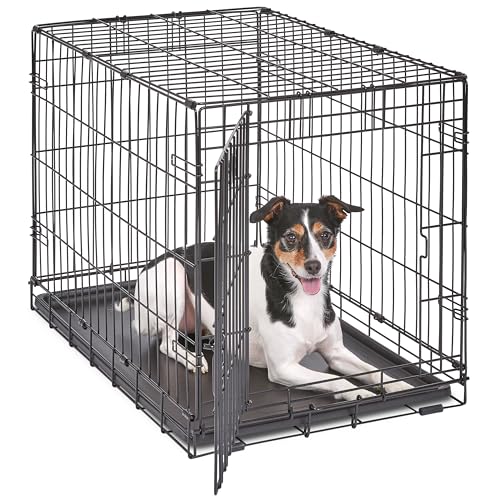
- IDEAL FOR 21-40 LB DOGS: Measures 30.5 x 19.25 x 21.5 inches - perfect for French Bulldogs, Welsh Terriers, Dachshunds & similar breeds. For dogs near 40 lbs, consider sizing up
- WE DON'T CUT CORNERS, WE PERFECT THEM: Precision welding, rounded corner clips & slide-bolt latch with Paw Block mitigate snags, cuts & escapes. With rigorous safety testing
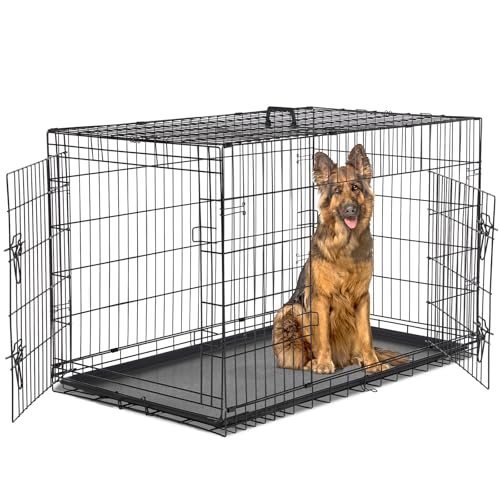
- Optimal Security: The rounded edges and smooth rounded corners, ensure a safe environment for your pet. The dog crate is equipped with thick metal mesh and doors, both featuring
- Sturdy & Durable: Our dog crates are constructed with high-quality materials to ensure durability. The robust construction guarantees that the crate withstands wear and tear
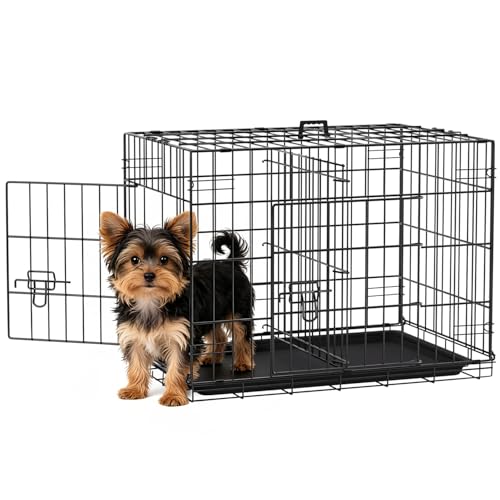
- 【Dog Crate Made of Durable Materials】: the dog crate Made of high Tensile-Strength wire gauge.The dog cage ideal for training and transporting well-behaved pets. Pet crate epoxy
- 【Designed to Safe and Comfortable】: The pet cage have two large doors, one on the front and one on the side, are easy to open, close.Heavy duty securely lock with dual latches
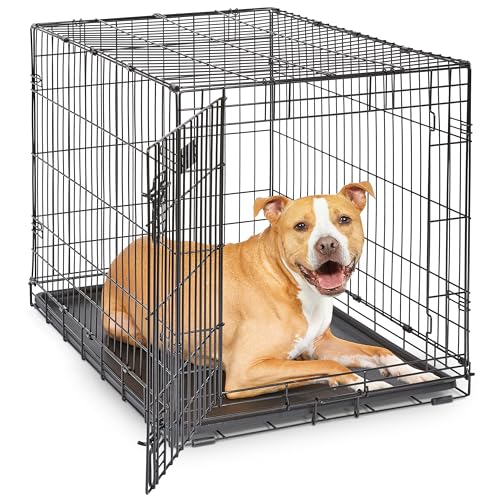
- IDEAL FOR 41-70 LB DOGS: Measures 36.5 x 23.25 x 24.75 inches - perfect for Bulldogs, Beagles, Whippets & similar breeds. For dogs near 70 lbs, consider sizing up to our 42-inch
- WE DON'T CUT CORNERS, WE PERFECT THEM: Precision welding, rounded corner clips & slide-bolt latches with Paw Block mitigate snags, cuts & escapes. With rigorous safety testing
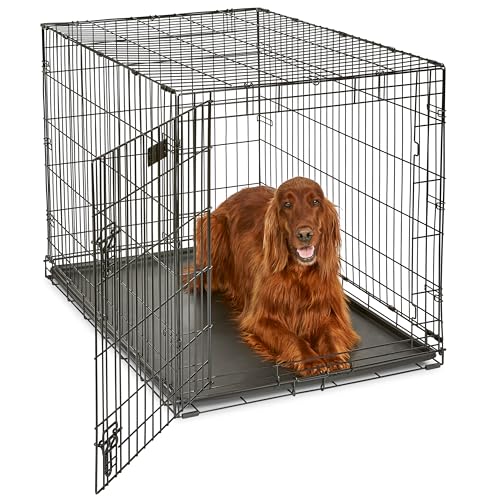
- IDEAL FOR 71-90 LB DOGS: Measures 42.5 x 28.5 x 30.5 inches - perfect for Australian Shepherds, Boxers, Golden Retrievers & similar breeds. For dogs near 90 lbs, consider sizing
- WE DON'T CUT CORNERS, WE PERFECT THEM: Precision welding, rounded corner clips & slide-bolt latch with Paw Block mitigate snags, cuts & escapes. With rigorous safety testing
Measure it properly — the five-minute version
Step 1. Get your dog standing on a flat floor. Not on a bed, not on a rug that swallows their feet. A tape measure and a treat is all you need. Gotcha: a wiggling dog gives you a short reading every time. Have someone hold a treat at nose height so they stand square.
Step 2. Measure length: nose tip base of tail. Base of tail means where the tail joins the body, not the tip. Gotcha: including the tail is the single most common measuring error, and on a Golden or a Lab it inflates your number by 8–12 inches, which pushes you into a crate a full size too big.
Finding the right how to measure dog for crate size comes down to matching the features to how you will actually use it.
Step 3. Add 2–4 inches to that length. That's your minimum interior length. Small dogs take the 2; big, long-bodied dogs take the 4.
Step 4. Measure height: floor top of head, sitting. Sitting, not standing. A sitting dog is taller than a standing one, and a dog that can't sit up without ducking will not settle in that crate. Gotcha: for breeds with erect ears — Shepherds, Malinois, many mixes — measure to the ear tips, not the skull.
Step 5. Add 2–4 inches to the height, then match to a crate. Now compare against the crate's stated dimensions. A 30-inch iCrate measures 30.5 x 19.25 x 21.5 inches; a 36-inch measures 36.5 x 23.25 x 24.75; a 42-inch measures 42.5 x 28.5 x 30.5. Those exterior figures are what "large dog cage measurements" actually mean in practice — the usable interior is slightly less once the tray and frame are accounted for.
Step 6. Sanity-check against weight. Weight ranges are a cross-check, not the primary measurement. MidWest rates its 30-inch for 21–40 lbs, the 36-inch for 41–70 lbs, and the 42-inch for 71–90 lbs. If your tape says 36 and your scale says 75 lbs, trust the tape but look hard at whether your dog is simply short and stocky.
Step 7. Measure the room, too. A 48-inch crate is over four feet long. Before ordering, chalk the footprint on your floor and live with it for a day. Doorway width matters if you plan to move it assembled.
What goes wrong
You measured to the tail tip. Symptom: the crate looks cavernous, your dog sleeps in one corner and eliminates in the other. Fix: re-measure to the tail base and either size down or install the divider panel to shrink the usable space.
You bought for the adult dog your puppy will become. Symptom: housebreaking stalls — the puppy has enough room to keep its bed clean and still soil the far end. Fix: buy the adult size but use the divider panel, moving it back as the dog grows. Both the MidWest iCrates and the FDW crate include a divider for exactly this.
You measured height standing. Symptom: the dog ducks or tilts its head to sit, and starts refusing to go in. Fix: re-measure sitting, to the ear tips, and size up.
You used nominal size as if it were interior size. Symptom: the crate is technically "36 inches" but your 34-inch dog is touching both ends. Fix: work from the stated dimension figures, not the size label, and keep your 2–4 inch buffer intact.
You didn't check the door side. Symptom: crate assembled, door opens straight into a wall or radiator. Fix: check single-door vs double-door before ordering. Double- and triple-door models give you placement flexibility a single-door model can't.
You crated an escape artist in a soft-sided crate. Symptom: chewed mesh, or a dog loose in the house. Fix: fabric crates suit calm, crate-trained dogs and travel; anxious or destructive dogs need welded wire.
Weight guidance where the manufacturer states it: 21–40 lbs for the 30-inch iCrate, 41–70 lbs for the 36-inch, 71–90 lbs for the 42-inch. MidWest also notes that dogs near the top of a range should size up.
When the fix is a new one
If your measurements don't match what you own, here's what each option changes about the problem.
FDW | 24" Foldable Metal Dog Crate | Black | Cage for Small Dogs — the entry point for genuinely small dogs
At 24 inches nominal and $22.99, this covers dogs whose nose-to-tail-base measurement lands around 20 inches. Two doors (front and side) solve the "door faces a wall" problem in tight rooms, it ships with a divider for puppies, and it folds to under 3 inches thick with a removable carry handle. Leak-proof ABS tray. Check the FDW 24" Foldable Metal Dog Crate listing and reviews yourself before committing.
MidWest Homes for Pets 30-Inch iCrate for Medium Breeds — published interior figures to measure against
The reason this one is easy to size is that MidWest publishes the numbers: 30.5 x 19.25 x 21.5 inches, rated 21–40 lbs, suggested for French Bulldogs, Welsh Terriers and Dachshunds. Divider panel included so it works from puppyhood, tool-free assembly, leak-proof tray, rubber feet. See the MidWest Homes for Pets 30-Inch iCrate spec sheet for the full dimension list.
MidWest Homes for Pets 36-Inch iCrate for Medium-Large Breeds — the 41–70 lb bracket
36.5 x 23.25 x 24.75 inches, cited for Bulldogs, Beagles and Whippets. MidWest's own advice is that dogs approaching 70 lbs should move up to the 42-inch, which is a useful tiebreaker when your tape lands on the boundary. Same slide-bolt latches with Paw Block, same divider system. Details on the MidWest Homes for Pets 36-Inch iCrate page.
MidWest Homes for Pets 42-Inch iCrate for Large Breeds — where "large dog crate dimensions" usually land
42.5 x 28.5 x 30.5 inches, rated 71–90 lbs, named for Australian Shepherds, Boxers and Golden Retrievers. That 30.5-inch height is the spec to check against your sitting-height measurement — it's the dimension most large-breed owners get wrong. The MidWest Homes for Pets 42-Inch iCrate listing lists the full construction details.
Aidoly Extra Large Dog Crate 48 Inch Double Door Pet Cage Kennel — one step beyond 42
When your measurement exceeds what a 42-inch crate gives you, 48 inches is the next standard step. Double doors with heavy-duty sliding bolt locks, rounded corners and edges, thick metal mesh, leak-proof ABS composite tray, tool-free assembly that folds flat for transport. Exact dimensions aren't published in the listing, so confirm them on the Aidoly Extra Large Dog Crate 48 Inch page against your own numbers before ordering.
XVISHX Dog Crate, 36x25x25 Inch, Light Grey — the travel-and-quiet-dog alternative
36 x 25 x 25 inches in a fabric build: thickened steel tube frame, 620D Oxford cloth, leather-wrapped corners, breathable mesh on all sides and the top, three doors, no tools to assemble. Lighter and foldable enough for one person to carry, which matters for car trips. The XVISHX 36x25x25 Inch Dog Crate is the option to look at if portability outranks chew resistance for your dog.
FAQ
How much extra room should a dog have in a crate? Two to four inches beyond nose-to-tail-base length and beyond sitting height. Enough to stand, turn around and lie flat — not enough to establish a separate bathroom corner.
What size crate for a 60 lb dog? Measure first, but 60 lbs sits inside the 41–70 lb band MidWest assigns to its 36-inch model (36.5 x 23.25 x 24.75 in). If your tape says the dog is longer than 32 inches nose-to-tail-base, go to 42.
Should I buy a bigger crate so my puppy can grow into it? Yes, but only if it has a divider panel. Buy the adult size, wall off the excess, and move the divider back as the puppy grows. Without a divider, an oversized crate actively undermines housetraining.
How do I choose the right size plastic or soft-sided crate? Same two measurements, same 2–4 inch buffer. The difference is that soft and plastic crates have thicker walls and internal frame members, so the usable interior is meaningfully smaller than the exterior figure — lean toward the larger size, and skip fabric entirely for a chewer.
Related guides
- About Nuzzleen: Our Editorial Team and Research Standards
- Best dog and cat supplies - dog crates, cat trees, dog beds, litter boxes, pet kennels and cat condos for First-Time Buyers
- Alternative Options for Best dog and cat supplies - dog crates, cat trees, dog beds, litter boxes, pet kennels and cat condos
Key Takeaways
- Choosing the right how to measure dog for crate size means matching the key features to your specific needs and budget
- Read real customer reviews and check the return policy before you commit
- Compare value across models — the priciest option is not always the best fit