As an Amazon Associate this site earns from qualifying purchases.
The specs, side by side
| Product | Height | Price | Scratching surfaces | Condo | Hammock | Base / footprint |
|---|---|---|---|---|---|---|
| Yaheetech 63in Sturdy Large Cat Tree for Indoor Heavy Cats, Tall Tower | 63 in | Check price on Amazon | 7 sisal posts + scratching board | Yes, up to 22 lb | Yes, up to 18 lb, machine-washable | 30.5″ × 19″ |
| Globlazer Heavy Duty Cat Tree, 70 inch Sturdy Cat Tree for Indoor Cats Extra Large Cat Tower with Scratching Post, Hammock, Cat Condo for Adult Cats Kittens, F70 Pro, Light Grey | 70 in | Check price on Amazon | 4 sisal posts + scratching board | Yes | Yes, enlarged square | Not stated |
| Sweetcrispy 54 Inch Cats Tree Tower with Scratching Post, Beige | 54 in | Check price on Amazon | 3 sisal rope pillars | Two condos | Not stated | 50 × 50 cm |
| Heybly Cat Tree with Toy, 43.3 inch Cat Tower for Indoor Cats HCT004SG | 43.3 in | Check price on Amazon | Sisal-wrapped posts (count not stated) | Not stated | Basket | Not stated |
| YUNIQUE Cat Tree with Cat Condo and Big Hammock, Grey | 39.37 in | Check price on Amazon | Natural sisal posts (count not stated) | Yes | Yes, removable and washable | 22.44″ × 13.78″ |
| Hey-brother Cat Tree Tower with Removable Toys, Scratching Posts, MPJ008SW | Not stated | Check price on Amazon | 3 scratching posts + scratch board | Yes | Basket-shaped | Not stated |
Quick answer: The cat tree your cat will actually use is the one whose height, perch size, and footprint match your cat and your room — not the one with the most levels. Start by measuring the space you can permanently give up, then match the tower's condo and hammock weight limits to your heaviest cat. For a large or multi-cat household, the Yaheetech 63in Sturdy Large Cat Tree for Indoor Heavy Cats, Tall Tower is the reference point in this guide because it publishes the numbers most listings hide.
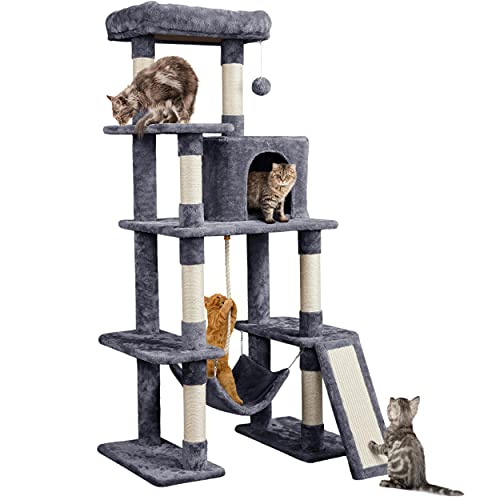
- Room for Every Cat, Every Mood: Five platforms, a 21″×15″ foam-edged perch, a cozy condo (up to 22 lb), and a hammock (up to 18 lb)—for three to four medium or two large cats
- Instinctive Scratching & Play: Respect their nature and your home's safety. This cat-approved cat tree tower has seven sisal scratching posts and a scratching board for daily
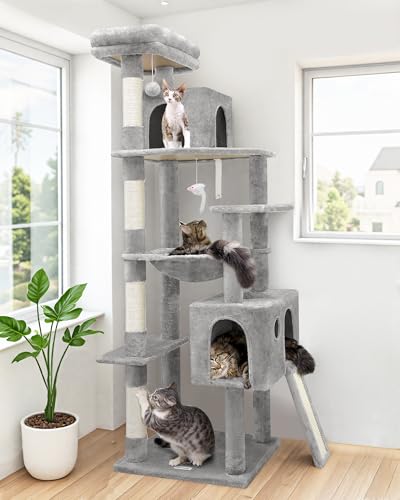
- ENLARGED HAMMOCK - This cat tree is Equipped with a sturdy and spacious square hammock, this large cat tree tower offers a comfortable resting spot for your adult cat. The hammock
- SPACIOUS AND COMFORTABLE CAT CONDO - This cat tower provides a spacious cat condo that allows cats to rest, hide, or play comfortably inside. The cat cave is a safe, private space
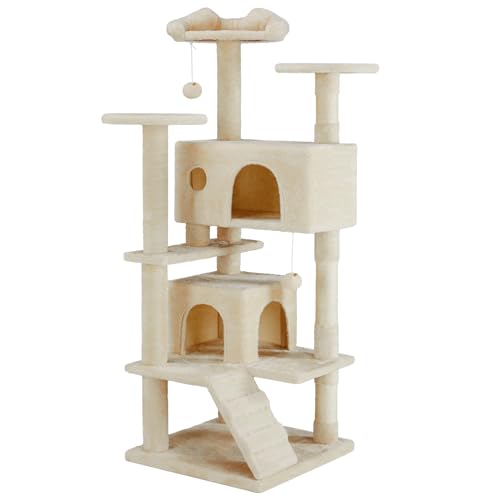
- Multi-Function Design: This cat tree is a versatile playground for your feline friend. With three climbable platforms, cat tower for indoor cats offers endless adventure and
- Cat's Entertainment Hub: Featuring three sisal rope pillars, cat tower with scratching post satisfies natural scratching instincts while the dangling balls with bells mimic the
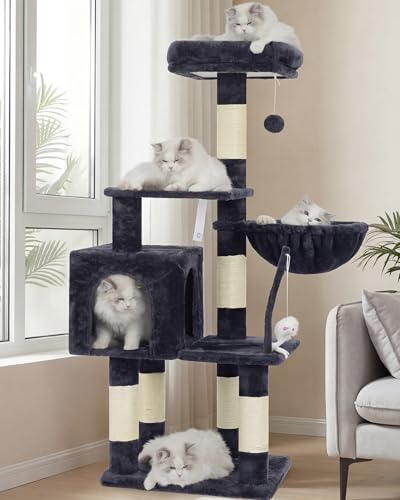
- Ideal design of structure: Structure of the cat tree is designed according the climbing habits of cats. Two jumping platforms not only increase the active space but also help
- Stability is the Primary Consideration for A Cat Tower: Sturdy cat climbing frame base, sisal wrapped scratch posts and Anti-toppling devices ensures the security of active
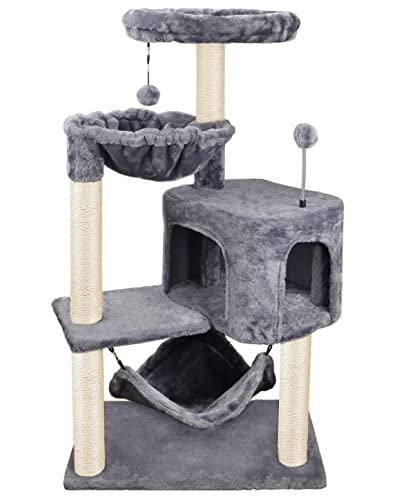
- Overall size:22.44"x13.78“x39.37"H. The big base board can increase cat tree's stability. Notice: Please try to place it against the wall
- High quality faux fur, natural sisal posts durable for long time scratch
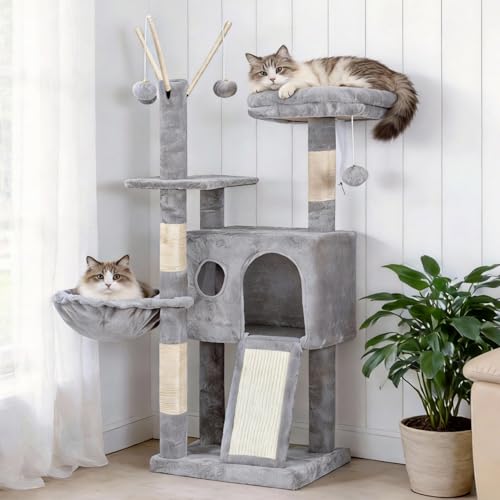
- 3 Removable Teaser Wands: The toys can be detached to interact with cats, and also can be installed back on the cat tree for independent feline fun. The rod body is wrapped with
- Multi-level Design with Clear Climbing Trajectory: This small cat tower is rich in functions but doesn't take up space. Both kittens and kitty with limited mobility can easily
The four numbers that actually decide this
Footprint, not height. Height is what the listing shouts about; footprint is what you live with. The YUNIQUE Cat Tree with Cat Condo and Big Hammock, Grey occupies 22.44″ × 13.78″ — roughly a large ottoman. The Yaheetech tower's base is 30.5″ × 19″, which is a meaningfully different object in a small apartment. Tape the dimensions out on your floor before you order anything.
Weight ratings on the soft parts. This is where most listings go quiet, and it's the single most useful spec for a big cat. The Yaheetech 63in Sturdy Large Cat Tree for Indoor Heavy Cats, Tall Tower states a 22 lb condo limit and an 18 lb hammock limit. Nothing else in this group publishes those numbers. If you have a Maine Coon or a chunky 18-pounder, a stated limit is worth more than an extra ten inches of height.
The best cat tree buying guide for your situation depends on how you plan to use it and where.
Perch size. Cats sprawl. A perch that's technically "large" but only fits a loaf-shaped cat gets used for five minutes. The Yaheetech lists a 21″ × 15″ foam-edged perch; the Globlazer F70 Pro's top platform is described as enlarged and detachable, which also means you can pull it off to wash it — a genuinely underrated feature on a surface that collects fur.
Scratching surface count and material. Sisal is the standard for a reason: cats can shred it and it doesn't fall apart. Seven posts plus a board on the Yaheetech is a lot of scratchable real estate; three posts on the Sweetcrispy 54 Inch Cats Tree Tower with Scratching Post, Beige is the low end. More posts matter most in multi-cat homes, where one cat camping on the good post is a real problem.
Who a tall, wide tower is for
Get the tall, wide, heavier build if you have more than one cat, a cat over roughly 15 lb, or a cat who currently scratches your furniture. The Yaheetech is described as fitting three to four medium cats or two large ones, with five platforms so cats can space themselves out — that separation is the whole point in a multi-cat house. It also ships with an anti-toppling kit and a reinforced washer, which matters when a heavy cat launches off the top.
You should also lean tall if your cat is a watcher — the kind who sits on the fridge or the back of the sofa. Vertical territory is what they're after, and the 70-inch Globlazer or 63-inch Yaheetech is what delivers it.
Who should skip a big tower entirely
Skip it if your cat is a kitten, a senior, or has joint problems. Tall towers with big gaps between platforms are a fall risk and, more commonly, just get ignored. The Heybly Cat Tree with Toy, 43.3 inch Cat Tower for Indoor Cats HCT004SG is designed around climbing habits with two jumping platforms specifically to help kittens and older cats get up and down. The Hey-brother Cat Tree Tower with Removable Toys, Scratching Posts, MPJ008SW makes the same argument — a multi-level design intended so kittens and cats with limited mobility can climb easily.
Skip it if you live somewhere small. A 30-inch-wide base in a studio is a piece of furniture you will resent. The YUNIQUE at 22.44″ × 13.78″ is honest about being the compact option.
Skip it if your cat has never used vertical space. Some cats are floor cats. A shorter tower with a good condo is a cheaper way to find out before you commit sixty-plus inches of your living room.
The honest trade-offs
Cheap towers cost more per year. At $35.99 to $49.96, most of this group is entry-level pricing, and entry-level pressed-board towers wobble as the fasteners loosen. The Yaheetech specifies FSC-certified, CARB P2 board, which at least tells you what you're getting; most listings don't say. The $96.99 Globlazer F70 Pro is the only one here priced like a durable-goods purchase rather than an impulse buy.
Anti-tip hardware is not optional and not always a real fix. The Yaheetech, Sweetcrispy, and Heybly all include anti-toppling devices. The YUNIQUE listing simply advises placing it against the wall. Either way, you're drilling into or leaning on a wall — plan the location accordingly.
Toys included are a bonus, not a reason to buy. The Heybly comes with a teaser stick and a bell ball; the Hey-brother has three detachable teaser wands; the Sweetcrispy has dangling bell balls. These are cheap to replace and shouldn't outweigh perch size or stability in your decision.
Assembly is real work. The Sweetcrispy lists around 40 minutes with numbered parts and a video tutorial. The Yaheetech states a single person can do it with the included tools and illustrated manual. Budget an evening either way, and expect to re-tighten everything after a month.
What to check on the listing before you buy
Listings change constantly — colorways get swapped, sizes get merged into one ASIN, and prices move.
- Confirm the price on the page, not in this guide. Everything here was accurate when written and may not be now.
- Check which variant is selected. Height and color are often separate options under one listing, and the 54-inch version and the 39-inch version can share a page. Verify the height in the cart, not the headline.
- Read the weight limits in the current bullet points. If a limit isn't stated on the live listing, assume it's modest.
- Look for the warranty or return window and whether replacement hardware is offered — on flat-pack furniture, a missing bolt is the most common failure.
- Go read the recent reviews yourself, filtered to the variant you're buying, and specifically look for photos from owners with cats your cat's size.
Globlazer Heavy Duty Cat Tree, 70 inch Sturdy Cat Tree for Indoor Cats Extra Large Cat Tower with Scratching Post, Hammock, Cat Condo for Adult Cats Kittens, F70 Pro, Light Grey — consider instead if…
…you want maximum height and you're willing to pay for it. At 70 inches it's the tallest here, and it's built around adult cats: an enlarged square hammock sized so a large cat can fully lie down, a spacious condo, and — the standout detail — two separate upward climbing routes, which reduces traffic jams in a two-cat home. The top perch detaches for cleaning. At $96.99 it costs roughly double the others, so this is the pick when you've decided the cheap tower isn't worth replacing twice. See the Globlazer Heavy Duty Cat Tree, 70 inch Sturdy Cat Tree for Indoor Cats Extra Large Cat Tower with Scratching Post, Hammock, Cat Condo for Adult Cats Kittens, F70 Pro, Light Grey listing for current specs.
Sweetcrispy 54 Inch Cats Tree Tower with Scratching Post, Beige — consider instead if…
…you want height without width. Its 50 × 50 cm footprint is compact for a 54-inch tower, which is the specific trade-off apartment dwellers are usually looking for: go up, not out. It has three climbable platforms, two condos rather than one, three sisal rope pillars, a climbing ramp, and an anti-tilt device. Two condos is the reason to pick it over a taller tower if you have two cats who don't share well. Details on the Sweetcrispy 54 Inch Cats Tree Tower with Scratching Post, Beige page.
Heybly Cat Tree with Toy, 43.3 inch Cat Tower for Indoor Cats HCT004SG — consider instead if…
…you have a kitten or a senior cat. Its structure is explicitly designed around cats' climbing habits, with two jumping platforms placed to help kittens and older cats get up and down rather than forcing big leaps. The padded top perch is removable, and there's a basket for cats who like enclosed spaces. Check the Heybly Cat Tree with Toy, 43.3 inch Cat Tower for Indoor Cats HCT004SG listing for the current configuration.
YUNIQUE Cat Tree with Cat Condo and Big Hammock, Grey — consider instead if…
…floor space is your binding constraint. At 22.44″ × 13.78″ × 39.37″ it's the smallest footprint here while still including a full condo, a round platform positioned for window-watching, and a removable, washable hanging hammock. Note the listing's own advice: place it against a wall for stability. The YUNIQUE Cat Tree with Cat Condo and Big Hammock, Grey page has the full dimensions.
Hey-brother Cat Tree Tower with Removable Toys, Scratching Posts, MPJ008SW — consider instead if…
…you want the lowest entry price and a play-forward design. At $35.99 it's the cheapest here, with three detachable sisal-wrapped teaser wands that work as interactive toys or clip back on for solo play, plus three scratching posts and a scratch board. The multi-level layout is built for easy climbing, and the basket-shaped hammock suits cats who like to be enclosed. Height isn't stated, so confirm it before ordering: Hey-brother Cat Tree Tower with Removable Toys, Scratching Posts, MPJ008SW.
FAQ
How tall does a cat tree really need to be? Taller isn't automatically better — usable is better. What matters is that the platforms are spaced so your specific cat can climb them without a scramble, and that the top perch is somewhere your cat wants to be, ideally near a window. A 43-inch tower a cat uses daily beats a 70-inch tower it ignores.
My cat won't use the new tree. What now? Location is the usual culprit. Move it next to a window or into the room where your cat already spends time, rather than tucking it in a spare corner. Scratching posts get used most when they're in the path the cat already walks.
How many scratching posts do I actually need? More cats means more posts, because one cat monopolizing the good post is a real source of conflict. The Yaheetech's seven posts plus a board is generous for a multi-cat home; three posts is workable for a single cat.
Are the weight limits worth worrying about? Yes, for the condo and hammock specifically. Those are the fabric-and-fastener parts that sag first. The Yaheetech states 22 lb for the condo and 18 lb for the hammock; if a listing doesn't publish a number, treat it as sized for an average cat, not a large one.
Related guides
- Best dog and cat supplies - dog crates, cat trees, dog beds, litter boxes, pet kennels and cat condos After Recent Issues
- Best dog and cat supplies - dog crates, cat trees, dog beds, litter boxes, pet kennels and cat condos Industry Trends
- Comparing Your Best dog and cat supplies - dog crates, cat trees, dog beds, litter boxes, pet kennels and cat condos Options
Key Takeaways
- Choosing the right cat tree buying guide means matching the key features to your specific needs and budget
- Read real customer reviews and check the return policy before you commit
- Compare value across models — the priciest option is not always the best fit